Observability for Autonomous Software

When Agents Outnumber Humans, Safety is Observability

The endpoint is where agents act. Origin observes what they do, traces why they do it, and maps how their behavior propagates across your organization - in real time.

The Problem

Endpoint security was built for human operators, not autonomous software

Endpoint detection was designed around a simple assumption: a human sits at a keyboard, and malicious activity looks different from normal activity. AI agents break both of those assumptions simultaneously.

No Semantic Context
Broken context

No Semantic Context

EDR records that a process spawned a child process. It does not record that an AI agent chose to refactor authentication middleware, read .env files, and triggered a network call to an unfamiliar endpoint. The causal chain, the why, is missing.
Behavioral Signatures Break Down
High noise

Behavioral Signatures Break Down

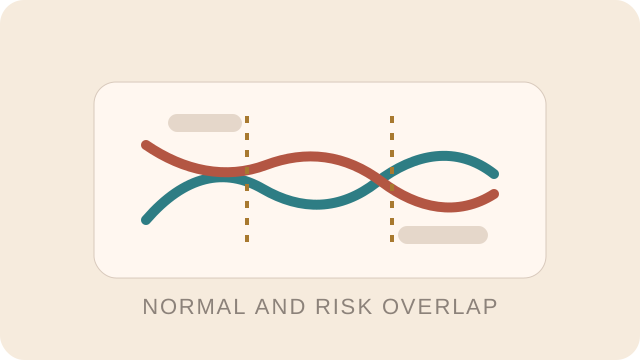
When an AI agent reads files, writes code, spawns processes, and opens connections as part of normal work, EDR heuristics turn into noise. The signal-to-noise ratio collapses. Legitimate agent behavior starts to look like lateral movement.

Semantic Attacks Are Invisible
Hidden intent

Semantic Attacks Are Invisible

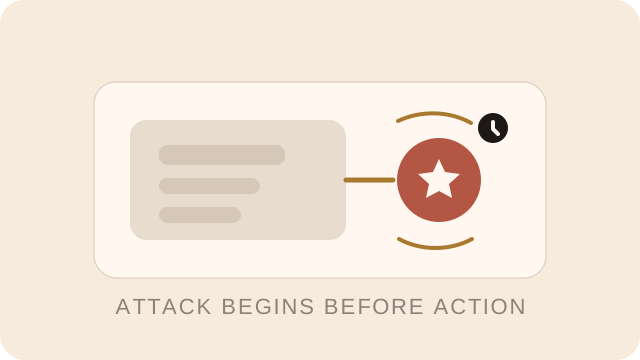
Injected instructions, context-window poisoning, and tool-call hijacking happen inside the agent’s reasoning layer. They leave no binary signature, suspicious file hash, or obvious network anomaly. Most endpoint tools do not even recognize this as a surface to monitor.

How Origin Works

See what agents actually did, not just what they say they did

Origin captures the full semantic trace of every AI agent operating on every endpoint: the prompt that started it, the reasoning chain that drove it, every file read, process spawned, and connection opened along the way.

Then it automatically clusters that behavior, so normal patterns emerge as recognizable topology - and anything anomalous stands out by contrast, not by signature.

Bind prompts to execution
Capture
Bind prompts to execution
Reconstruct why a step happened
Interpret
Reconstruct why a step happened
Find outliers by topology
Compare
Find outliers by topology
Semantic Trace — Prompt to Execution
Prompt

User prompt intercepted and extracted from API call

"Refactor the auth middleware to use the new JWT library. Update all tests."
Reasoning

Agent decomposes task into 4 sub-operations - file reads, dependency install, code modification, test execution

6 files readnpm install3 files modified
Execution

Agent reads .env and config/secrets.yaml - access attributed to auth refactor task

READ .env → DATABASE_URL, API_SECRET READ config/secrets.yaml → production credentials
Sensitive file accessCredential exposure
Side Effect

Outbound connection to unfamiliar endpoint - not part of declared task scope

POST api.unknown-service.io/v1/validate → payload contains JWT secret
Undeclared network callData exfiltration riskScope violation
Clustered

Session classified as atypical - credential access + undeclared network call deviates from “Auth Refactoring” cluster baseline

Outlier behavior detected
What Observability Unlocks

Human observability enables agent accountability

Without semantic observability at the endpoint, none of this is possible. With it, security teams gain an entirely new operational surface - one that matches the speed and complexity of the agent workforce itself.

Activity Attribution
Investigations

Trace any incident to its origin prompt

Follow the semantic thread backward from system effect to tool call to reasoning step to the exact prompt that initiated the chain.

Audit & Compliance

A complete record of every agent decision

Every prompt, every reasoning step, every file access, and every connection opened is captured, attributed, and searchable.

Fleet Awareness

Know which agents are operating and where

Discover every AI agent running across the endpoint fleet, including ones nobody explicitly deployed or approved.

Behavioral Baselines

Detect anomalies by understanding normal

Topic clustering establishes what typical agent behavior looks like for each team, workflow, and role.

Policy Enforcement

Define boundaries in semantic terms

Move beyond binary allowlists to policies that understand intent, scope, and side effects rather than just process names.

Threat Detection

See attacks in the reasoning layer

Prompt injection, context poisoning, and tool-call hijacking become visible before they resolve into system effects.